Design Docs in the AI Era
In The Three Levels of Agentic Coding, I said the biggest risk with AI coding is losing your mental model of the codebase, and that understanding your data model is the best defense. This post is about how to share that understanding with your team.
How It Started
Design docs used to be a Word doc, or a Markdown file if you were a little more nifty. You wrote up what you were going to build and shared it with your team for feedback. How formal that was depended a lot on the company, but for bigger features, a few engineers often split up the work and built it together. And once the code shipped, the doc usually went stale.
How It’s Going
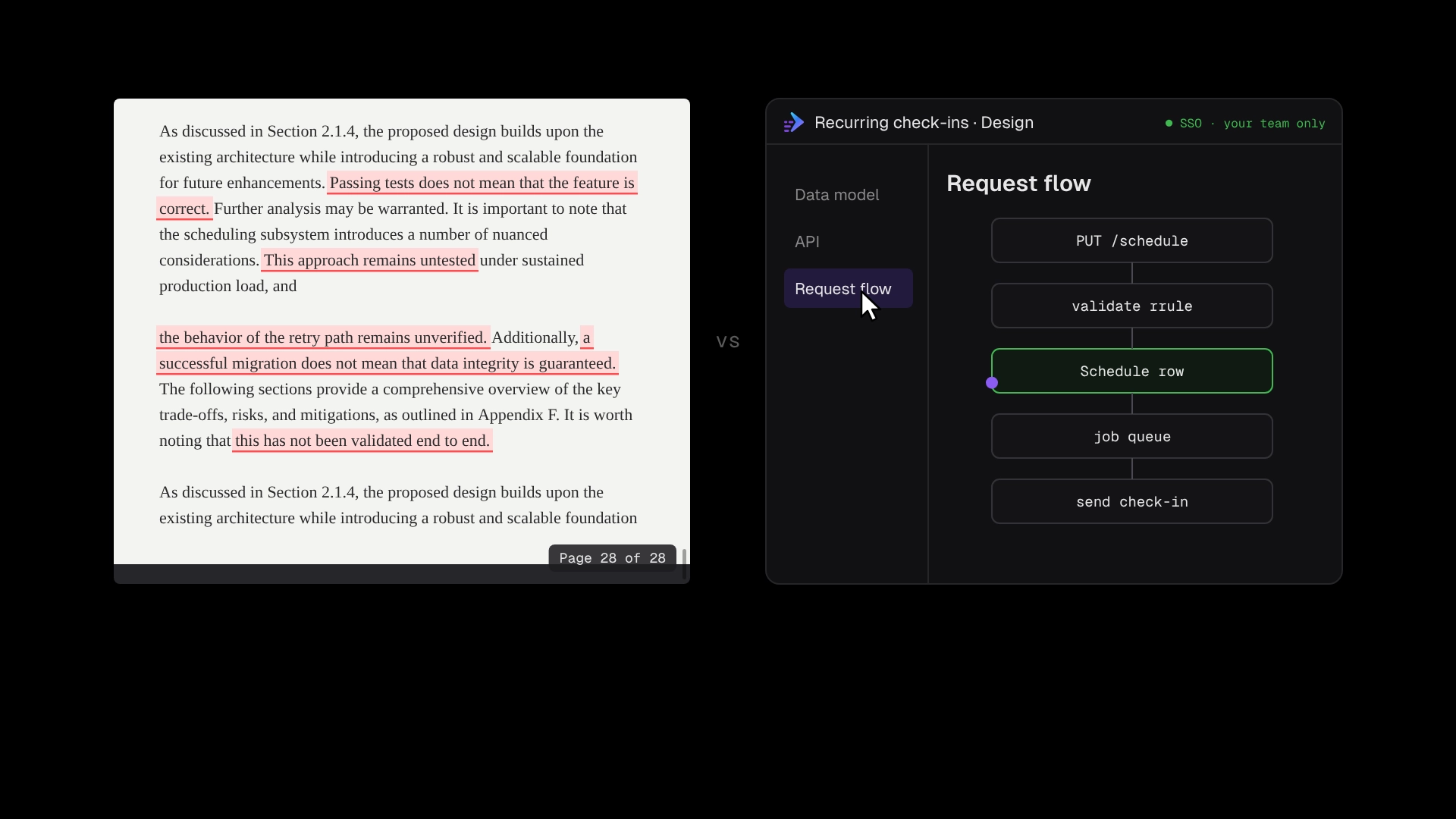
Then people realized AI could write the design doc for them. Next thing you know, someone’s sharing a 28-page design doc and asking for reviews, and it’s pure AI slop. It goes into way too much detail on things that don’t need it, and it’s full of AI artifacts: “this remains untested,” “this remains unverified,” “X does not mean that Y is true.” Nobody has time to read that, and nobody wants to.
The way we build has changed too. With agents, one engineer can build a much bigger feature end to end, so there’s less need to split the work across several people. That means the person presenting the design is usually the same person who builds all of it.
Two Artifacts
I think a good design now has two parts, at two different times.
Before you build: a short doc. This should be mostly human-written. Use AI to help with wording if you want, but you should be the one writing it. Keep it high level and skip details that don’t matter. Use whatever format is easy for your team to share and comment on.
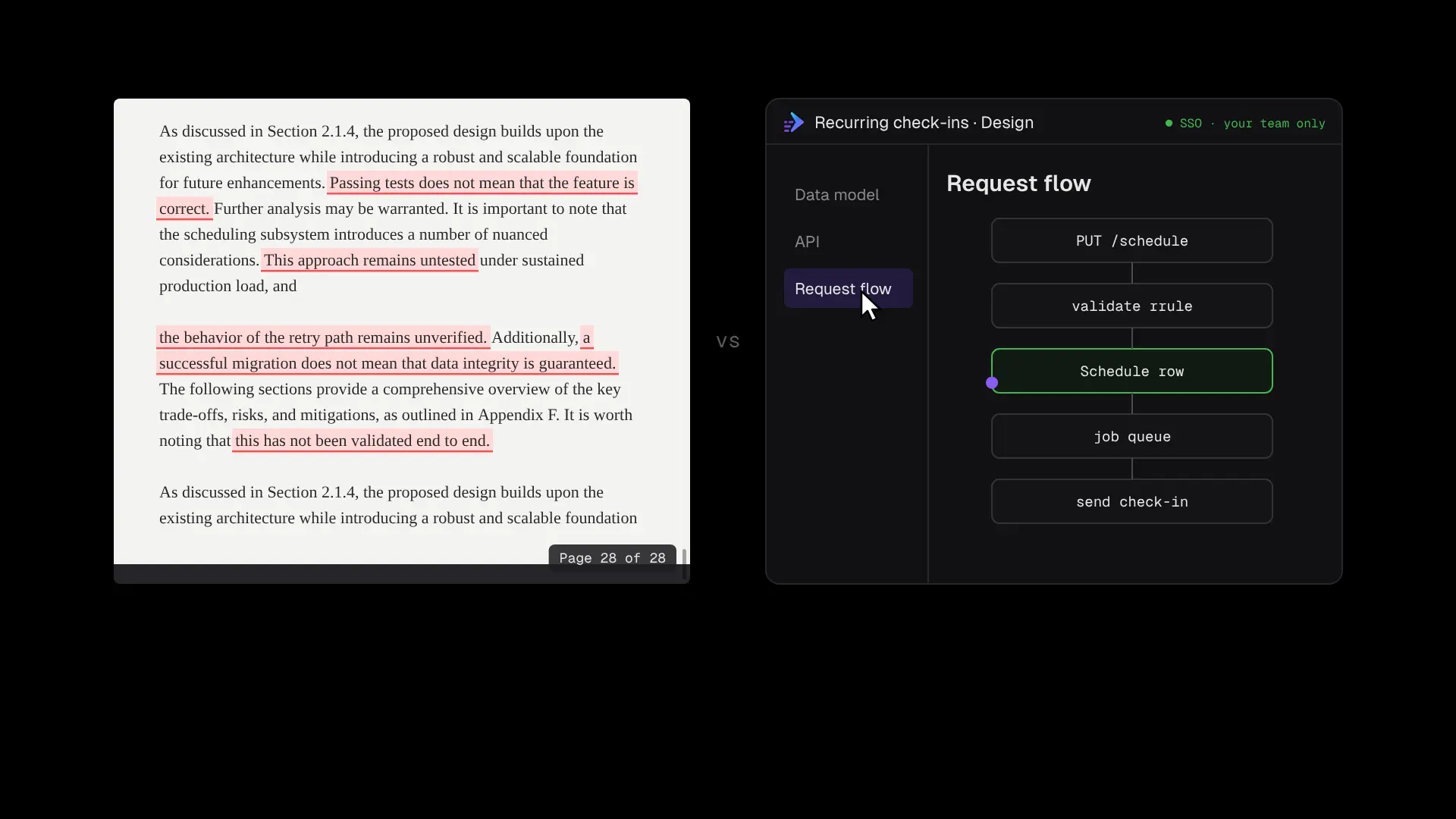
After you build: an app. This is where AI is great. Agents are very good at building small websites, so once the feature is built, have one build a little web app that shows how it works: the data models, how they relate, what changed, how a request flows through the system. It goes into much more detail than the doc, but it’s way easier to understand than a wall of text. We’re all tired of reading Word docs.
The app doesn’t replace code review, it makes it easier. Before reviewers dig into thousands of lines in a diff, they can click through a picture of what the code does, so they know where to focus their attention. Link it from the PR so it’s right there for whoever is reviewing.
What to Focus On
In both the doc and the code review, spend your attention on the things that are hard or impossible to change later: data models, customer-facing APIs, and anything other teams or customers will build on. Get those wrong and you’re stuck with a migration, a breaking change, or a compatibility workaround forever.
Everything else matters a lot less now. With agents, code is cheap, so implementation details can be changed quickly and easily in the next PR. Don’t burn design review time debating them.
This is the same idea as Level 2 in The Three Levels of Agentic Coding: read what’s hard to change.
Hosting Them
My team at work has been doing this a lot. We have agents build small HTML or React apps for our designs, then host them on App Service Builder, a new platform my team has been building. It deploys automatically when you push to GitHub and has built-in single sign-on (which I built, so I’m a little biased). That part matters: you’re publishing what is basically a real website, and SSO locks it down so only your team can open it, without you setting up any auth yourself.
The Problem: They Disappear
Here’s the issue we’re running into. After the PR merges and time goes on, we clean up old apps, and then they’re gone. The best explanation of how a feature works vanishes right when someone new needs it.
A Bit of a Wild West
Yes, this can also turn into everyone building their own little app for every feature. But that’s not much different from everyone writing their own Word or Markdown docs in their own formats, scattered across emails, SharePoint, hard drives and repos.
I expect this to get standardized eventually. I haven’t figured out what that looks like yet, but probably something where an agent builds the app and hosts it, with some guardrails: everything in one place, formatted similarly, and kept around after the PR merges. Most of these apps are just static content, so they don’t even need a full runtime platform (although being able to deploy real APIs is what makes App Service Builder more powerful for other things).
For now, I think it’s pretty cool. Keep the doc short, write it yourself, and let the agents build the pictures.
I work at Microsoft on Azure App Service. The views in this post are my own and don’t represent Microsoft.
← Back to blog